As much as you can get away with!!! Drag race starts are unique in that you have the ability to store inertia energy prior to the start. The faster you can spin the engine before the clocks start, the more inertia energy will be available to help move the car with the clocks running. The key to making all this work is being able to control the rate that the additional stored energy is fed into the tires/chassis.
In the graph above, lines A,B,C, and D represent different draw rates that the clutch is pulling down a 600ft/lb engine after a WOT launch.
Line "A"- The clutch is pulling engine rpm down way too fast. Even if the engine still magically made 600ftlbs at 1800rpm, that's only 205hp at the low point of the bog. Obviously, this 60' is going to suck!
Line "B"- The slower pulldown rate raised the rpm/mph sync point to about 2800 at 20mph, but still only 320hp at the low point of the bog.
Line "C"- Much better pulldown rate, now rpm stays above 3700. The engine is now up to about 420hp at the low point of the bog.
Line "D"- That extra slip time allows the engine to stay closer to its rpm sweet spot for HP production. The engine is now up to about 550hp at the low point of the bog.
Another consideration is the difference in engine rpm on the starting line vs engine rpm crossing the finish line. If the starting line rpm is lower than finish line rpm, that means over the course of the run the engine's rotating assy will absorb more energy than it gives back. This in-turn reduces the overall amount of energy available to accelerate the car.
But what would happen if the engine in that graph above were capable of raising the launch rpm from 7174 to 9000, with shift points/etc all remaining the same? The answer is the amount of stored energy available to assist launch would almost double, from 30.03 to 59.57 units of inertia. If you draw that 59.57 units in the same 0.589sec time frame that the 30.03 units were drawn out, the hit on the input shaft almost doubles in intensity, which would likely either break something or knock the tires completely loose. But if you use a clutch hit controller to draw that 59.57 units at same draw rate as the 30.03 unit hit, the intensity of the hit does not increase but the stored energy assist now lasts almost twice as long. The engine's power curve does not need to extend to 9k to exploit this, just capable of spinning 9k on the starting line without flying apart. Just an example of what the ability to control inertia draw rate can allow you to do.
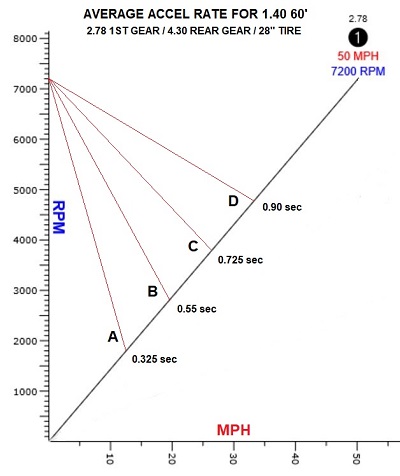 The general idea is to gear the car to keep the engine riding the plateau of its HP curve throughout the run. If hi-rpm clutch hit is going to pull the engine down about 2000rpm, and the engine's torque peak is around 5200, launch rpm should be at least 7200 so that the engine doesn't get pulled down below the rpm where it pulls it's hardest. This approach makes best use of your ability to store energy prior to the start, also helps keep your engine rpm up where it's making more average hp.
Chapter 01- The Basics of Inertia Management
Chapter 02- Calculating Inertia's Effect on Input Shaft Torque
Chapter 03- Clutch Slip After the Shifts... Good or Bad?
Chapter 04- Heavier Cars LESS Likely To Break Transmissions?
Chapter 05- Understanding The ClutchTamer
Chapter 06- Understanding The Hitmaster
Chapter 07- The Basics of Analyzing Dragstrip Data
Chapter 08- Flywheel Weight- Heavy or Light?
Chapter 09- Choosing a Proper Clutch & Pressure Plate
Chapter 10- The Importance of a Clutch Pedal Stop
Chapter 11- What's the Best Launch RPM?
Chapter 12- Do You Need a 2-Step Rev Limiter?
Chapter 13- Traction Problems- Adjust Shocks, Chassis, or Clutch?
Chapter 14- Are "Clutchless" Shifts Right For You?
Chapter 15- Traction Control- Yes or No?
Chapter 16- Apply ClutchTamer Tech to an Adjustable Clutch?
CHANGING THE GAME ON LAUNCHING YOUR STICK SHIFT CAR!!!